
Why Hong Kong Photography Works as Wall Art
Hong Kong doesn’t photograph like other cities, and it doesn’t hang like other cities either. There’s a density to it — buildings stacked against buildings, neon pressed up against laundry lines, harbour light bouncing off glass — that somehow still leaves room to breathe. That contradiction is what makes it effective on a wall.
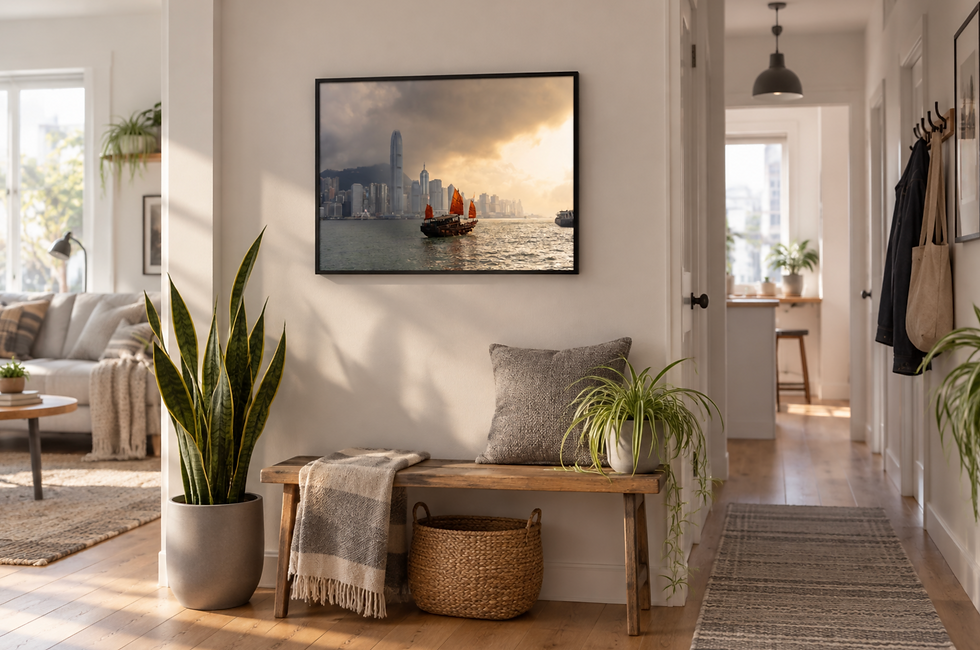
Most skyline photography reads as a single idea: impressive, cold, finished. Hong Kong resists that. One frame can hold a wet market stall, a hillside of apartment towers, and a stretch of open harbour at the same time. It’s busy and calm together, which is hard to find in wall art and harder to grow tired of.
Why These Scenes Feel Different Indoors
A lot of city photography works as spectacle — one big dramatic skyline meant to impress for a week and then fade. Hong Kong images tend to hold attention longer because they’re layered. There’s a near layer, a middle layer, and a far layer, and your eye moves between them differently depending on the light and the time of day.
That layering comes from the geography. The city sits compressed between mountains and water, so the stacking is already there: green peaks behind glass towers behind boats on the harbour. Photographers don’t have to invent depth. It’s built into the land.
Hong Kong also puts density and openness in the same composition. A tight street scene next to a wide harbour view creates a rhythm across a wall — tight, then open, then tight again. That rhythm is what makes a group of pieces from the collection feel deliberate rather than random. (More on arranging them in the styling guide.)
The Visual Qualities That Suit Interiors
A few qualities in Hong Kong photography translate especially well to framed prints and canvas:
Light on concrete and water.
The light hits wet pavement, glass, and harbour water and throws it back differently depending on the humidity and the hour. That soft reflectiveness prints well, especially in rooms where the light changes through the day.
Vertical density.
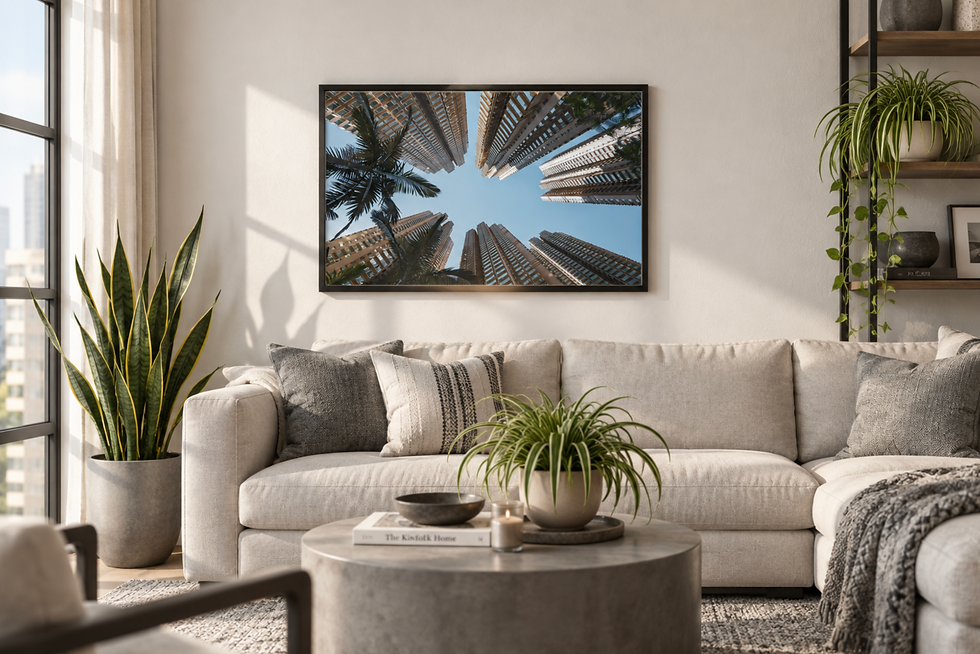
Housing blocks shot straight on or from below turn into graphic, almost abstract patterns. In modern or minimal rooms they often read more as texture than as a literal photo of a building.
Pockets of green.
Most of Hong Kong is hillside and country park. A trail, a reservoir edge, or a hillside dropping into the city gives a visual rest next to denser shots. They ground a room full of harder lines.
Night market energy.
Warm neon, movement, steam from food stalls — these carry a kind of life daytime shots don’t. They suit spaces where you want warmth and a bit of story: a dining room, a hallway, a corner you actually sit in.
Aerial and harbour views.
Wide shots across the harbour, especially at dusk, give a room scale without shouting. They tend to anchor a wall rather than compete with it.
Framed vs Canvas
Not every Hong Kong image wants the same treatment.
Dense, detailed shots — a crowded street, a wall of windows, a night market — usually do better framed behind glass in a slim black or dark frame. The detail is the point, and glass keeps the lines sharp. A thin frame also stops the image feeling boxed in when the subject is already busy.
Wide harbour and skyline shots with soft light or a dusk palette often suit canvas. The texture works with the atmosphere, and calmer compositions can handle the slight softening canvas brings.
Green space and nature-adjacent shots lean the same way. They’re usually warmer and less graphic, and canvas gives them a softer, more organic feel.
Scale matters more than people expect. A dense street scene printed small can feel cramped. The same image larger lets the detail resolve and gives the eye room to move. Busier compositions generally benefit from going larger. (Sizing and frame choices are covered in more depth in the buying guide.)
The Moods This Collection Can Create
A Hong Kong collection doesn’t lock you into one mood.
A harbour-at-dusk canvas in a living room reads calm and slightly cinematic. A framed night market shot in a hallway or kitchen adds warmth and movement. A vertical housing-block print in a study can feel graphic and almost sculptural. A hillside or green-space print in a bedroom softens the room without fighting the rest of the palette.
Because the source material already contains density and openness, warm and cool tones, structure and nature, it stays flexible. Most single-city collections give you one visual mood. Hong Kong gives you several, all true to the same place.
Bringing It Into Your Space
Hong Kong photography works on a wall because the city already does the compositional work — stacking density against openness, concrete against water, neon against quiet hillside. What’s left is choosing which version of that contrast fits your space and how you want to present it.
Frameifi ships framed prints and canvas pieces from this collection free to the US, UK, Europe, and Australia/ New Zealand.
If you want to see the range — street scenes, harbour views, night markets, and the quieter green corners — browse the Hong Kong collection.


Comments