
Hong Kong Wall Art Styling Guide for Living Rooms, Bedrooms & More
Updated: 3 days ago
Buying a Hong Kong print is the easy part. Figuring out where it actually belongs — what size, what frame, what wall — is where most people get stuck. This is the practical follow-up to why Hong Kong photography works as wall art, with the numbers instead of the theory.
Living Rooms: Go Bigger Than You Think
Living rooms are where the wide harbour and skyline shots earn their keep. These images are calm enough to hold a large wall without taking over the room, and small versions of them tend to disappear.
As a rough guide, art above a sofa should cover about two-thirds the width of the sofa. For a standard 7-foot (213 cm) sofa, that means a single piece around 48–60 inches (122–152 cm) wide, or a multi-panel arrangement that adds up to the same width with even spacing.
For a dusk harbour shot or a wide skyline, canvas works well. The texture suits the atmosphere, and at that size a frame behind glass can catch reflections depending on where the windows are. If the room gets strong afternoon light, canvas avoids the glare problem.
If you’re going dense instead of wide — a street scene or a stacked housing-block shot — frame it. A slim black wood frame keeps the detail sharp and gives a busier image a clean edge. Natural wood softens it slightly and suits rooms with warmer tones or wood furniture.

Bedrooms: Quieter Images, Softer Frames
Bedrooms are where the green space and hillside shots do the most work. A reservoir trail or a misty hillside doesn’t compete with the room the way a dense street scene would, and it doesn’t need to be large to feel present.
Above a bed, aim for a width about 50–60% of the headboard. For a queen bed (60 inches / 152 cm), that’s roughly 30–36 inches (76–91 cm). For a king (76 inches / 193 cm), closer to 40–45 inches (102–114 cm).
Canvas suits bedrooms particularly well — no glass means no glare from a bedside lamp or morning light. If you prefer a frame, natural wood or white keeps things soft. Black can feel a bit sharp in a room meant to wind down.
Avoid putting a high-energy night market shot directly across from the bed. It’s striking, but busy, and busy isn’t usually what you want to wake up to. Save it for a hallway or living space.
Hallways and Entryways: Let Dense Shots Lead
Hallways are narrow and usually seen in passing, which is where the denser, more detailed images work. A crowded street, a wall of neon, a tight alley — these reward a second look, and a hallway naturally invites one.
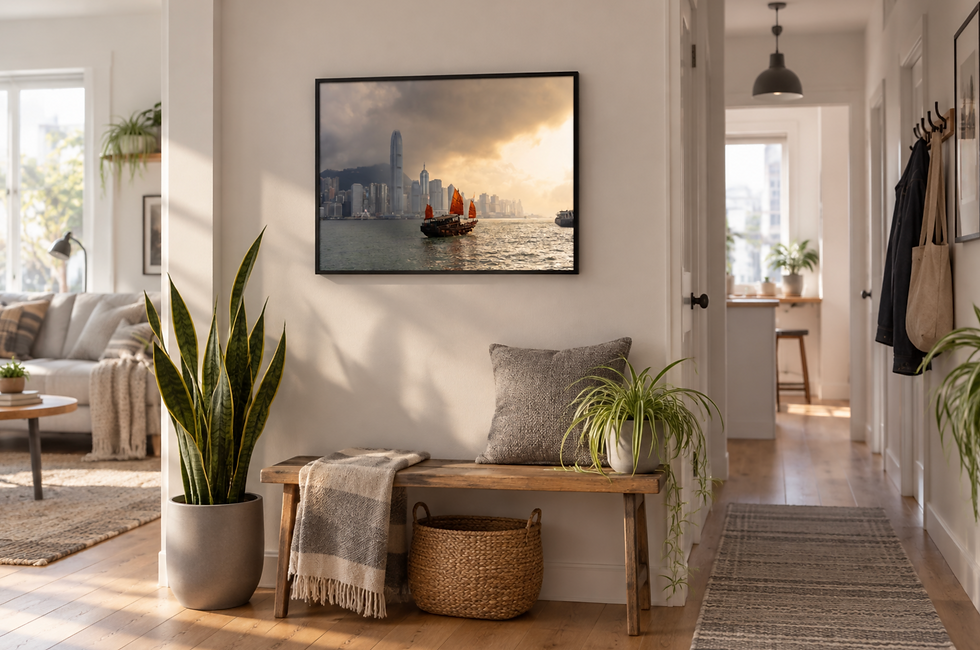
Because hallways are often narrow, go smaller and more frequent rather than one oversized piece. Three or four prints at 11×14 inches (28×35 cm) or 16×20 inches (41×51 cm), spaced 3–4 inches (7–10 cm) apart, read better than a single large piece you can’t step back from.
Frame these. Glass protects them in a high-traffic area, and a slim black frame keeps a row of mixed images looking like a set. If the hallway has a window at one end, angle the framed pieces slightly away from that light or use canvas in that spot to avoid glare.
Home Offices: Graphic and Structural Works Best
Offices suit the more abstract, pattern-like shots — straight-on housing blocks, repeating window grids, aerial views of dense rooftops. These read as almost architectural rather than literal, which fits a workspace without becoming a distraction.
A single piece at 24×36 inches (61×91 cm) on the wall facing your desk, or behind you for video calls, works well. Framed with a thin black or dark metal frame, they hold their graphic quality and look intentional.
Skip canvas here if the room is small. In a tight office, texture close-up can feel busier than it needs to. Save canvas for the wider, calmer harbour shots if you want something that isn’t work-related.
Common Issues and How to Avoid Them
Scale.
The biggest mistake is sizing art to the wall instead of the furniture below it. Measure against the sofa, bed, or desk first. The wall itself is less relevant.
Glare.
Framed pieces behind glass in bright, sun-facing rooms will catch light at certain times. If you like a framed look but the room is bright, look at matte or anti-glare glass, or use canvas on that wall.
Pairing with other art.
Hong Kong images are visually rich enough that they don’t need much company. If you’re mixing them with other pieces, keep the frame finishes consistent — all black, or all natural wood — even if the subjects differ. It reads as considered rather than cluttered. More detail on sizes and finishes is in the buying guide.
Start With the Room, Not the Image
The easiest way to style this collection is to pick the room and its mood first, then choose the image and finish to match, rather than falling for a photo and forcing it somewhere it doesn’t fit.
Framed and canvas pieces ship free to the US, UK, Europe, and Australia, so testing a size or changing a frame later isn’t a costly decision.
Ready to find the right piece? Browse the Hong Kong collection.
Comments