
Ernst Haeckel Collection Guide: Which Nature Prints Suit Which Room
Ernst Haeckel was a 19th-century biologist and illustrator. His studies of jellyfish, diatoms, orchids, and other marine forms turned scientific observation into images that still look striking on a wall. For the full background on his life and work, see our earlier guide to Ernst Haeckel. This post is more practical: which prints suit which rooms, and how to choose from the Ernst Haeckel collection.
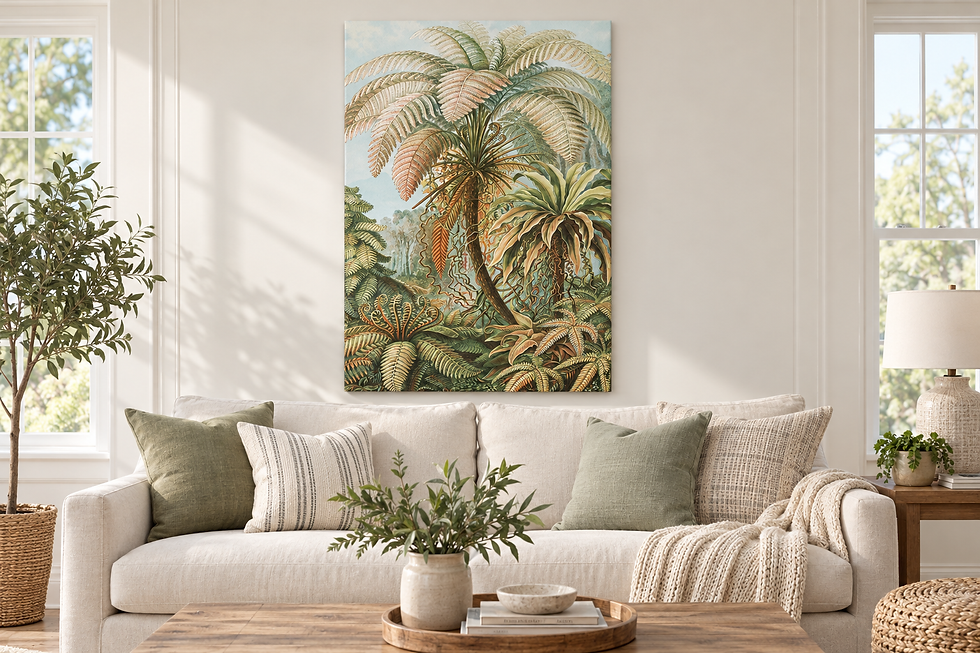
Ernst Haeckel Filicinae Tree Fern Landscape
Ernst Haeckel’s Filicinae Tree Fern Landscape is a striking scientific illustration of fern forms, drawn from his celebrated Art Forms in Nature. With its intricate fronds and structured composition, this vintage botanical study brings quiet detail and classic character to modern interiors — ideal as a ready-to-hang framed print for living rooms, studies, and considered spaces.
Living room: statement pieces
Living rooms can handle Haeckel’s busier plates. Composite illustrations of radiolarians or siphonophores have enough detail to read from across the room and still repay a closer look.
Go larger here. A statement size around 24×36 in (61×91 cm) usually anchors a wall better than a small print that gets lost. Black-and-white plates feel graphic against contemporary furniture. Softly tinted botanical studies sit more easily with wood, linen, and warmer textures.
If you’re choosing one anchor piece, the jellyfish and radiolarian plates often carry a wall well because of their symmetry and visual weight.
For pairing and lighting ideas, see our styling guide on decorating with Ernst Haeckel.

Ernst Haeckel Orchidae Orchid Bouquet
Ernst Haeckel’s Orchidae Orchid Bouquet is an intricate scientific illustration of orchid forms from his celebrated Art Forms in Nature. With its detailed petals and elegant composition, this vintage botanical study brings quiet beauty and classic character to modern interiors — ideal as a ready-to-hang framed print for living rooms, studies, and considered spaces.
Bedroom and calm spaces
Bedrooms suit quieter subjects. A single moss, fern, or simple marine specimen usually feels better than a dense, high-contrast composition.
Keep sizes modest to medium — around 16×20 in (41×51 cm) works well. A pair on either side of the bed often looks more considered than one large print. Softer, muted tones tend to fit restful rooms, though that depends on your existing palette.
Office and study
Studies are a natural fit for Haeckel’s denser plates: diatoms, cross-sections, and detailed taxonomic groupings. These are rooms where you sit with an image, so linework you can actually read from a chair matters.
Black-and-white or black-framed options often suit this setting and give a specimen-catalogue feel beside bookshelves and desks. A mid-to-large size such as 18×24 in (46×61 cm) is usually enough to show the detail without overwhelming the wall.

Ernst Haeckel Batrachia Frog Gathering
Ernst Haeckel’s Batrachia Frog Gathering is a detailed scientific illustration of amphibian forms from his celebrated Art Forms in Nature. With its precise study of frogs and natural structure, this vintage natural history print brings quiet curiosity and classic character to modern interiors — ideal as a ready-to-hang framed print for living rooms, studies, and considered spaces.
Hallway and gallery wall sets
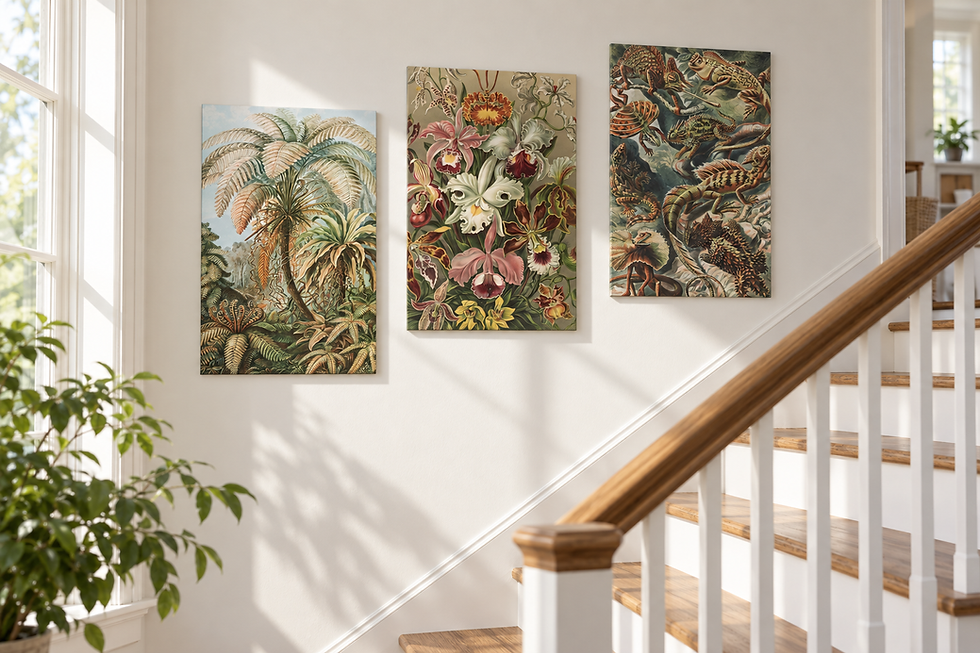
Hallways and stairwells work better with grouped sets than with a single large piece. People pass them at different angles and distances.
Three to six smaller prints in matching frames read as a set rather than a random scatter. The 12×16 in (30×41 cm) size is useful here — easy to group on a narrow wall. Mix specimen types, such as a jellyfish, a fern, and a diatom, and keep the frame finish consistent so the wall still holds together.
For more on spacing and gallery layouts, the styling guide covers that in more depth.

Framed prints are the most flexible option. They suit most rooms in this guide, protect the work, and finish the edge cleanly whether you hang one piece or a set. Natural wood, black, and white frames make it easier to match existing furniture and colour.
Canvas has more presence without glass or a visible frame edge. That can suit larger living-room or study pieces where you want the image itself to do the work.
Either way, keep prints out of direct sun. Light fades them over time, regardless of format.
Haeckel prints in the collection range from 12×16 in (30×41 cm) to 24×36 in (61×91 cm). A simple guide:
- 12×16 in (30×41 cm): gallery walls, hallway sets, bedside pairs
- 16×20 in to 18×24 in (41×51 cm to 46×61 cm): bedrooms, offices, secondary living-room walls
- 24×36 in (61×91 cm): living-room statement walls, above sofas or consoles
When in doubt, measure the wall first. Aim for the print, or group of prints, to fill roughly 60–75% of the available width.
Black-and-white vs color
Haeckel’s plates range from stark black-and-white engravings to softly tinted botanical and marine studies. Black-and-white suits modern and minimal rooms and pairs easily with black frames. Tinted plates bring warmth and work better with wood tones, linen, and softer colour schemes. Neither is better in general — match the print to the room.
How many to hang together
- One: living rooms and studies, as a statement piece
- Two: bedrooms, or symmetrical placements either side of furniture
- Three to six: hallways, staircases, gallery walls
Matching frames matters more than matching every subject. A shared finish lets you mix specimens freely.
Final thoughts
Haeckel’s illustrations work across rooms because they were built on observation and structure, not decoration. That is why they still fit so many different interiors.
Frameifi offers free shipping to the US, UK, Europe, and Australia.


Comments