
Decorating with Ernst Haeckel: Japandi, Minimalist & Maximalist Ideas

Ernst Haeckel’s natural history prints still look surprisingly modern. His jellyfish, diatoms, and orchids started as scientific studies, but the symmetry, limited colour, and sense of order in them fit the way a lot of people decorate now. You’ll see them in Japandi flats, minimal rooms, and busy gallery walls for the same reason: the images are strong without being loud.
If you want background on Haeckel himself, we covered his life and work in an earlier post. This one is about hanging the prints so they actually work in a real room.
Japandi likes empty wall space, muted colours, and objects that feel natural and deliberate. Haeckel fits that well. Stick to the quieter plates — a single orchid, fern, or jellyfish — rather than the crowded composite sheets packed with dozens of organisms.
Frame choice matters. Oak, ash, or pale walnut keeps things warm. A thin black frame adds structure without fighting the room. White frames often look a bit cold against wood and linen.
Don’t go oversized. A print around 30×40 cm (12×16 in) to 50×70 cm (20×28 in), with plenty of wall left around it, usually looks better in a minimal room than a big statement piece. The space around the image is part of the effect.
Maximalist gallery walls
Haeckel’s original Kunstformen der Natur plates already grouped related forms together, so gallery walls suit them. Mix different specimens — radiolarians, anemones, mosses — in a few sizes. You can also pair a Haeckel plate with a vintage botanical or a black-and-white nature photo. That tends to create rhythm rather than clutter.
Keep the frames consistent. All black or all natural wood is safer than mixing finishes, especially when the images already vary. Use a couple of larger pieces as anchors and smaller studies around them.

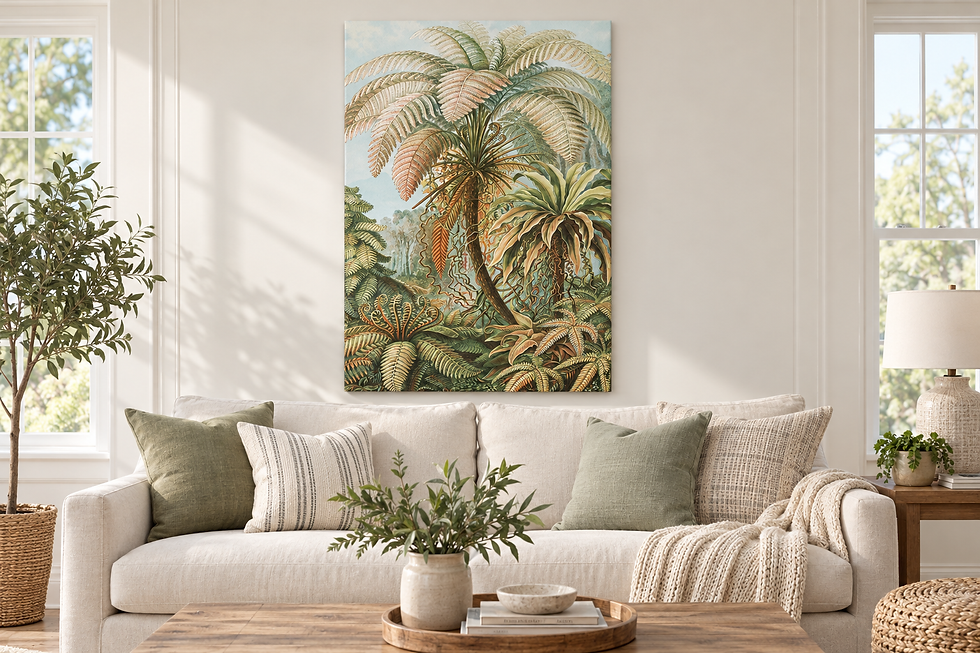
In a living room, Haeckel works either as one clear piece above a sofa or console, or as a tight pair or trio. For a single statement print, choose one of the more detailed plates — siphonophores, radiolarians, or the denser composites. They hold up from across the room and still reward a closer look.
Black frames suit contemporary furniture, leather, and darker wood. In warmer rooms with rattan, linen, or terracotta, natural wood usually ties in better.
Watch the light. Direct sun fades prints over time, and glare on glass hides fine line work. A picture light, or simply a spot away from harsh sun and evening glare, helps.

Bedrooms suit Haeckel’s quieter subjects: mosses, lichens, simple marine forms, softer tones. You want something calm enough to live with, not something that dominates the room.
Medium or smaller sizes work well above a bed, scaled to the headboard, or as a pair beside a window. White or natural wood frames fit most restful schemes. Save black frames for bedrooms that already run high-contrast and graphic.
Check the print under your actual bedside lighting. Warm lamps change how colours read at night.

Home offices and studies
This is where the scientific detail earns its place. Use the denser plates — diatoms, radiolarians, botanical cross-sections — at a size you can actually read while sitting nearby.
Black frames often suit studies. They give a catalogued, specimen-on-the-wall feel. Haeckel also pairs well with Japanese botanical woodblocks or old scientific diagrams if you want a small cabinet-of-curiosities corner without overcrowding the room.
A few practical rules that apply across rooms:
Frames
Black works in graphic rooms and mixed gallery walls. Natural wood suits Japandi, bedrooms, and warmer palettes. White is fine in bright modern spaces, but can feel cold in wood-heavy rooms.
Size
Smaller single-specimen studies suit minimal rooms, bedrooms, and tight groupings. Larger, more detailed plates work better as statements in living rooms and studies. As a rough guide, smaller studies often sit around 30×40 cm (12×16 in), while statement pieces commonly land near 50×70 cm (20×28 in) or larger.
Pairing
Haeckel sits easily with other botanical illustration, Japanese woodblock prints, and black-and-white nature photography. Shared subject or palette matters more than matching period or frame style exactly.
Light
Keep prints out of direct sun. Think about artificial light too, especially with glass in the frame.
Haeckel’s plates adapt well because they weren’t made as decoration. They’re observational and structured, which is why they fit so many different rooms without looking trendy.
When you’re ready to choose one, browse the full Ernst Haeckel collection — from single botanical studies to detailed composites for a statement wall.

Comments