
Best Framed Botanical Wall Art for Your Living Room: Bringing Nature Home Without the Watering Can

There’s something about botanical wall art that just feels right in a living room. Maybe it’s the quiet way a well-chosen leaf or flower print softens the edges of everyday life. Or how it somehow makes a space feel calmer, more intentional, and a little more connected to the outdoors—even if the only greenery you currently keep alive is the stubborn plant in the corner that refuses to die.
If you’ve been staring at a blank wall above the sofa, or that awkward empty stretch by the window, and thinking “something natural would look good here,” you’re in the right place. Framed botanical art has become one of the most reliable ways to elevate a living room without turning it into a greenhouse or committing to a full gallery wall of random prints. And when it’s already framed, ready to hang, and thoughtfully chosen? Even better.
At Frameifi, we live and breathe this stuff. We’re a small family business—Anthony’s the landscape photographer, I’m the painter and illustrator—and our shared love of the natural world shows up in everything we select and create. We cut out the middlemen, the expensive framing trips, and the guesswork so you can get solid wood frames, museum-quality prints, and free worldwide shipping in one straightforward package. Made to order. No waste. And every purchase helps fund carbon removal and reforestation. But enough about us. Let’s talk about what actually works on your walls.
Why Botanical Art Belongs in the Living Room
Living rooms are the heart of the home. They’re where you flop after a long day, host friends, watch bad reality TV, and occasionally try to look put-together when someone drops by. The art in this space has to do a lot of heavy lifting. It needs to feel welcoming without being overly formal, interesting without shouting for attention, and flexible enough to work with whatever else is going on in the room—sofa color, rug texture, the pile of books that never quite gets put away.
Botanical prints handle all of that surprisingly well. They bring soft organic shapes and natural color palettes that play nicely with almost any style: modern, traditional, Japandi, coastal, farmhouse, or that comfortable mix most of us actually live with. Greens, soft neutrals, muted florals, and earthy tones tend to calm a space rather than compete with it. And because plants and flowers have been part of art for centuries, they carry a quiet timelessness that doesn’t date as quickly as trend-driven abstract pieces sometimes do.
There’s also the biophilic design angle, if you want to get a little science-y about it. Surrounding ourselves with nature imagery has been shown to reduce stress and improve how we feel in a space. You don’t need a forest outside your window. A few well-placed botanical prints can give you a similar mental reset every time you walk into the room.
The Styles That Work Best
Not all botanical art is created equal, and what looks perfect in one living room can feel off in another. Here’s a practical breakdown of the styles we see people loving most right now.
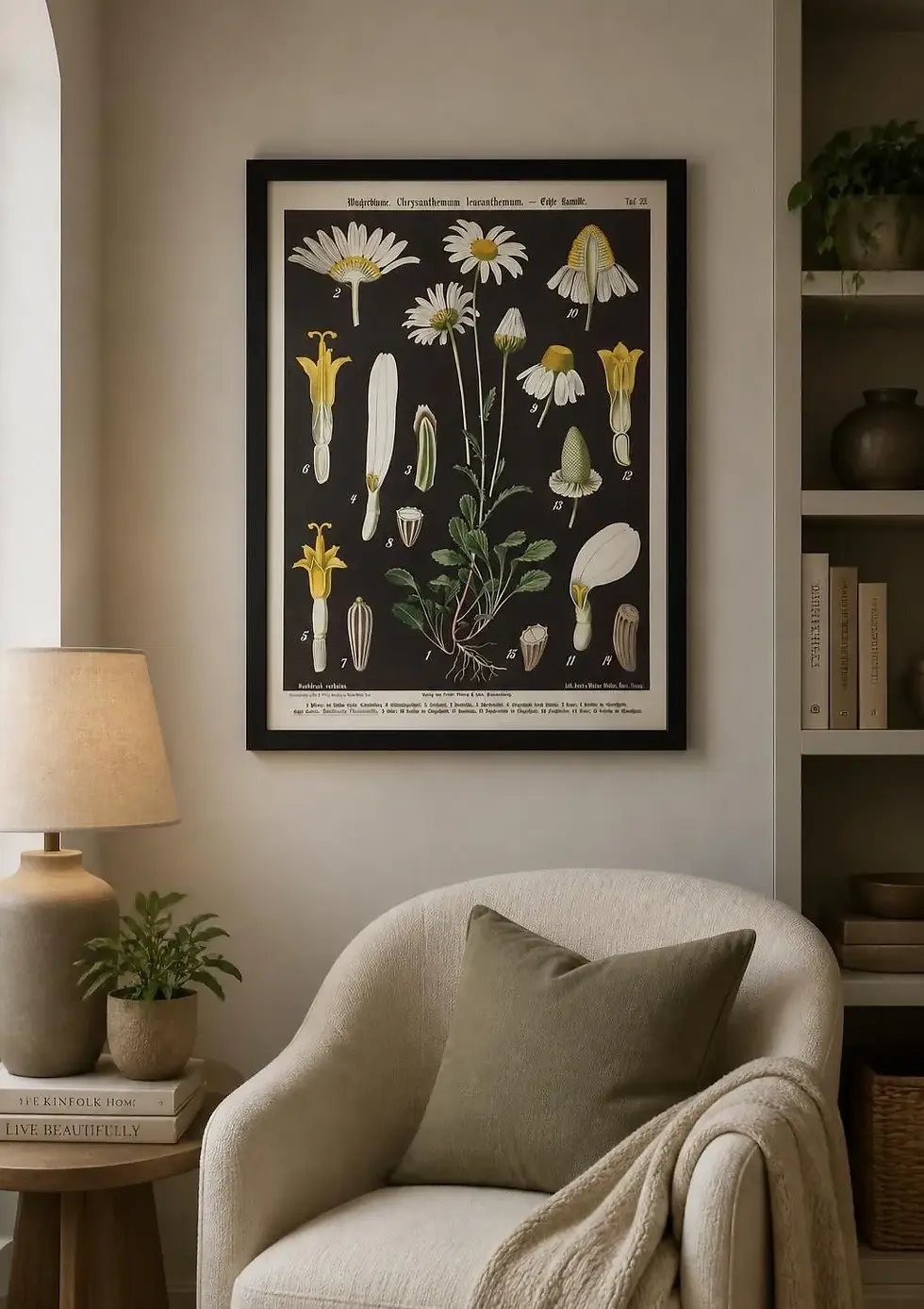
Think detailed plant studies, vintage herbarium-style prints, or those elegant old scientific drawings of leaves, flowers, and seed pods. These have a refined, almost scholarly quality that works beautifully in traditional or transitional living rooms. Pair them with a natural wood or simple black frame and they look expensive and intentional. They’re especially good if you like a slightly layered, collected look rather than ultra-minimal.
Minimal line botanicals

Simple outlines of eucalyptus branches, single stems, or delicate leaves against a clean background. These are the ones that feel modern and airy. They suit Scandinavian, Japandi, and contemporary spaces perfectly. Because the designs are restrained, they don’t overwhelm smaller rooms or compete with textured sofas and natural materials.

Palm fronds, monstera leaves, tropical flowers—these bring energy and a touch of the exotic. Great for brighter living rooms or spaces that lean coastal or maximalist. Just be mindful of scale. A huge tropical print can dominate a room in a good way, but it needs enough wall space to breathe.
Soft floral and wildflower pieces

Lavender fields, cherry blossoms, pansies, abstract wildflower gardens. These add a gentle romantic or seasonal feel without tipping into fussy. They’re versatile and tend to photograph (and live) beautifully above sofas or consoles.

Close-ups of real leaves, pressed-looking florals, or atmospheric nature studies. These feel more contemporary and grounded. Many of the photography pieces in our collection come from Anthony’s own work or artists who share the same outdoor sensibility, so they carry a quiet authenticity.
How to Choose the Right Size and Placement
This is where a lot of people get stuck. The “too small above the sofa” problem is real. A tiny print floating alone above a big couch looks lost. As a general rule, aim for the artwork (or grouping) to span roughly two-thirds the width of the furniture below it. For a standard three-seater sofa, that often means one large piece or a carefully spaced set of three medium ones.
Above a sofa or console, center the art so the middle of the piece sits at about eye level when you’re standing—usually 57–60 inches from the floor to the center. Leave a comfortable gap of 6–10 inches between the top of the furniture and the bottom of the frame so it doesn’t feel cramped.
Gallery walls work wonderfully with botanicals. Start with a larger anchor piece and build around it with smaller complementary prints. Keep the frames consistent (or deliberately mixed but cohesive) and the spacing even—usually 2–3 inches between frames. The result feels collected rather than chaotic.
Single statement pieces are equally powerful. One oversized botanical in a solid wood frame can quiet a busy room and give the eye a place to rest. We offer refined sizing options that make this decision easier—no endless custom sizing rabbit holes.
Frame Choices That Actually Matter
The frame is half the story. A beautiful print in the wrong frame can fall flat. At Frameifi we use solid Ayous wood frames, 0.75 inches thick, sourced from renewable forests. They’re substantial without being heavy, and they come in classic finishes—black, brown (natural wood tones), and white—so you can match your existing décor.
Black frames sharpen line drawings and monochrome botanicals and feel modern. Natural wood frames soften green-heavy pieces and reinforce the organic theme. White frames lift the art off deeper wall colors and keep things light. The acrylic front protector is safer than glass (especially with kids or pets) and still crystal clear.
Because everything is made to order, you get the quality of a custom frame without the custom price or the weeks of waiting at a traditional framer.
Styling Ideas That Feel Real
Here are a few combinations we’ve seen work beautifully in actual living rooms:
- A large eucalyptus line-art print in a natural wood frame above a beige or linen sofa. Soft, modern, and endlessly calm.
- A set of three classic botanical illustrations in matching black frames, hung in a horizontal row above a console. Instant collected elegance.
- One oversized tropical leaf or cherry blossom piece as the focal point on a feature wall, balanced by simpler furniture.
- Mixing a photography botanical with a couple of vintage-style florals for a layered, personal look.
- Pairing botanical art with neutral textiles, natural materials (wood, rattan, linen), and a few real plants so the whole room feels cohesive rather than themed.
Lighting matters too. Soft natural light or a picture light above the art makes the details pop in the evening. Avoid harsh overhead spots that create glare on the acrylic.
Practical Tips for Buying and Living With It
Look for museum-quality matte paper and archival printing so the colors stay true over time. Water-based inks and careful production processes help with that. Ready-to-hang is a genuine gift—no extra trips, no measuring for mats, no waiting for a framer who might take three weeks.
Think about your wall color. Soft greens and neutrals work almost everywhere. Bolder botanicals can handle stronger wall colors if the palette has some shared tones. And don’t be afraid of scale. Living rooms can handle bigger art than most people initially think.
If you’re building a collection over time, stick to a consistent frame style or a tight color story so everything feels intentional as you add pieces.
Why Ready-to-Hang Framed Art Makes Sense
We’ve all been there: you fall in love with a print online, order it, then realize you still need to get it framed, choose a mat, wait, pay more, and hope it all matches. Or you buy a cheap frame that warps or looks flimsy. Ready-to-hang pieces remove that friction. You choose the art and the frame finish, it arrives protected and ready, and you hang it the same day. Free worldwide shipping removes another barrier.
Because each piece is made to order, there’s no excess inventory sitting around. It’s better for the planet and means you get something that was produced specifically for you.
Final Thoughts: Make It Yours
The best framed botanical wall art for your living room isn’t the one that looks perfect in someone else’s Instagram photo. It’s the one that makes *you* feel a little happier every time you walk into the space. The one that softens the room, adds a quiet bit of nature, and somehow makes the whole place feel more like home.
Whether you’re drawn to delicate line drawings of eucalyptus, classic scientific botanicals, soft wildflower fields, or bold tropical leaves, the right piece is out there. And when it comes already framed in solid, responsibly sourced wood, with quality printing and free shipping, the decision gets a lot easier.
Browse the botanical collection, pick something that speaks to you, and hang it. Your living room—and your future self walking into it after a long day—will thank you.
Nature doesn’t have to live only outside. Sometimes the best version of it is already framed and waiting for a wall.
Alexis Anne
Painter and Curator


Comments