
How to Bring Japandi Style Into Your Home (Without Overdoing It)
Japandi looks simple from the outside. Soft neutrals, clean lines, a few well-chosen objects. In practice, that’s exactly why it’s easy to get wrong. Too little and the room feels unfinished. Too much “minimal” and it starts to feel cold.
If you’re still getting clear on what the style actually is, start here: What Is Japandi Style? A Calm Guide to the Aesthetic Everyone Is Drawn To. This guide is the next step — how to bring it into a real home without forcing it.
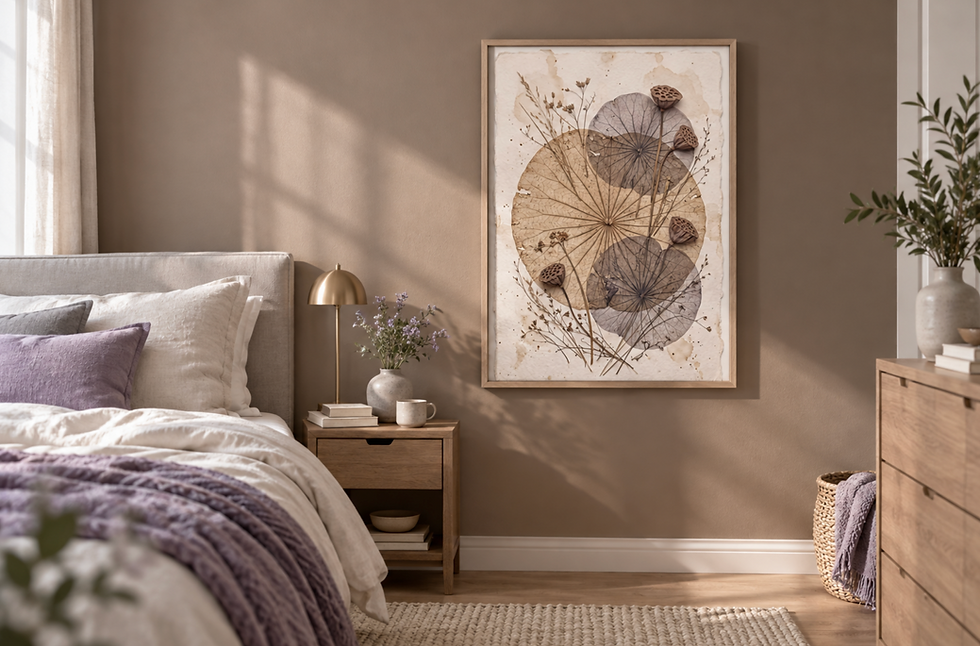
1. Start with the palette, not the products
Japandi colour is quiet on purpose:
Oatmeal, sand, soft greige
Clay, warm stone, muted taupe
Moss, sage, soft charcoal
Occasional deep black for contrast
Avoid bright accents and high-saturation colour. If a piece of furniture, textile, or art pulls the eye too hard, it usually doesn’t belong.
Tip: Paint and large textiles set the temperature of the room. Get those calm first, then choose art and objects that sit inside that range.
2. Choose fewer pieces — and better ones
Japandi is not about empty rooms. It’s about intention.
Before you add something, ask:
Does this earn its place?
Does it add warmth, texture, or quiet structure?
Would the room feel better without it?
A single solid wood side table will usually look more “Japandi” than three decorative objects competing for attention.
3. Prioritise natural texture over pattern
Pattern can work in small doses, but texture does more of the work:
Linen bedding and curtains
Light or raw wood
Stoneware and simple ceramics
Woven baskets, wool, or cotton
These materials keep the room from feeling flat without adding visual noise.
4. Protect negative space
This is the part people skip.
Leave wall space, shelf space, and floor space open. Japandi rooms breathe because they are allowed to. If every surface is styled, the calm disappears — even if every object is “minimal.”

A useful rule: one strong focal point per wall or zone, then stop.
5. Get the furniture silhouette right
Look for:
Low or mid-height profiles
Simple legs and clean edges
Minimal ornament
Comfort that doesn’t rely on bulk
You don’t need a full furniture replacement. Editing what you already have — removing the busiest pieces, keeping the quietest ones — often gets you most of the way there.
6. Choose wall art that supports the room
Because Japandi interiors are restrained, art carries more weight than in a maximalist space. The wrong print can make the whole room feel off. The right one can settle it.
Strong Japandi wall art usually has:
Muted, nature-led colour
Simple composition with breathing room
Organic subject matter (plants, landscapes, soft abstracts)
A calm presence rather than a loud statement
This is where many generic “minimalist” prints fall short. They’re clean, but they don’t feel warm or natural enough.

For a deeper look at the botanical side of this, and pieces made specifically for quieter rooms, see: Quiet Japandi Botanicals: Wall Art for Calm, Intentional Homes.
A simple Japandi checklist
Neutral, earthy palette in place
Natural textures added (linen, wood, ceramic)
Furniture edited down to cleaner forms
Negative space protected
One or two calm art pieces chosen with care
You don’t need to transform the whole house at once. One quieter room — a bedroom, a reading corner, a living-room wall — is often enough to feel the difference.
Japandi works best when it feels lived-in and deliberate, not staged. Choose less, choose well, and let the space breathe.


Comments