
Coastal Wall Art Styling Guide for Living Rooms, Bedrooms & More
Coastal photography fits a lot of homes without much effort. The colours are usually soft, the subjects are natural, and the images rarely clash with furniture or existing schemes. The harder part is getting size, frame, and placement right so the print actually belongs on the wall.
This guide covers practical choices for different rooms and styles — from living rooms and bedrooms to minimal and warmer coastal-inspired spaces.

Living rooms: make it a statement
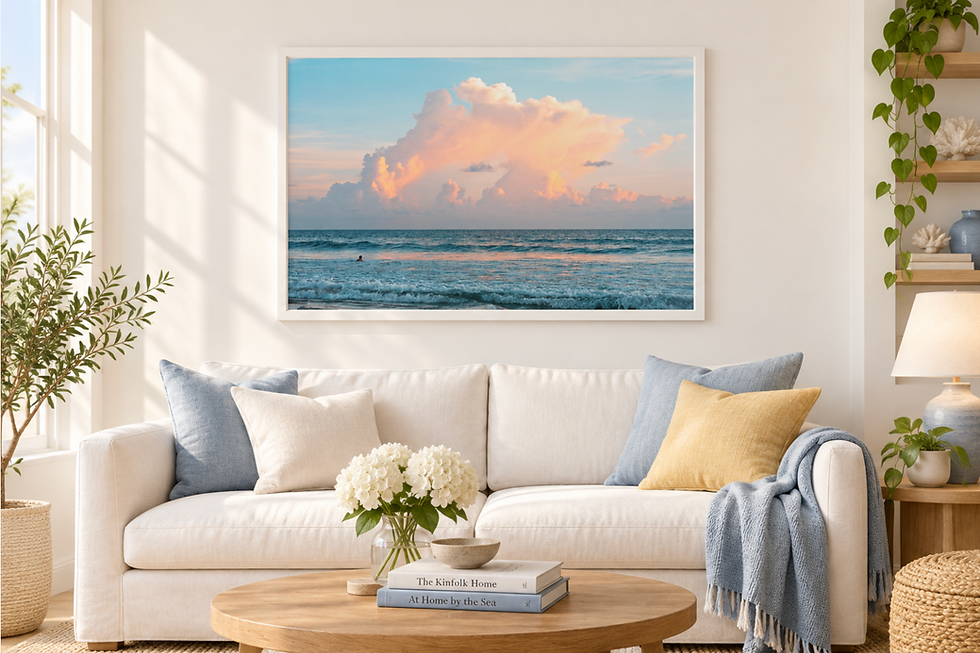
Living rooms can usually take a stronger image. You have the wall space and the viewing distance. A dramatic coastal scene — storm light, a wide shoreline, or a high-contrast seascape — works well as one large piece above a sofa or console.
As a rough guide, aim for artwork that covers about 60–75% of the furniture width below it. For a standard three-seat sofa, that often means something around 100–150 cm wide (40–60 in). If you prefer a group instead of one large print, two or three coastal images — a wide view mixed with a tighter detail — can carry the same weight.
Bedrooms: keep it calm
Bedrooms suit quieter images. Flat water, soft skies, a simple horizon with plenty of empty space. Save the high drama and strong contrast for other rooms. Here you want a print that settles the space.
Placement matters more than maximum size. A single calm print centred above the headboard, about two-thirds the width of the bed, usually looks intentional without dominating the room. For a queen or king, that often lands around 80–120 cm wide (32–47 in).
Hallways and gallery walls
Hallways are good for range. People pass through them rather than sit and stare, so smaller and medium prints often work better than one oversized piece. A short sequence — wide shoreline, closer texture, then a view from above — can give a sense of movement as someone walks through.
On a gallery wall, keep the framing consistent: same frame colour, similar mat widths. Leave about 5–8 cm (2–3 in) between frames so the group feels connected without looking crowded.
Minimal and Japandi rooms are a natural fit. Both the style and the photography lean on restraint, natural materials, and empty space. Abstract coastal textures — sand, water patterns, weathered rock — often work especially well here. They read as form and texture more than literal scenery, which matches the understated palette of these interiors.
One well-placed print, usually in a thin natural wood or black frame, tends to beat a cluster of smaller pieces. One considered choice is enough.
Warmer, textured coastal-inspired rooms
Not every coastal room is cool and minimal. Spaces built around linen, rattan, warm wood, and layered texture can take coastal photography too — especially images with sand tones, golden light, or weathered surfaces. In these rooms, canvas often suits better than a hard frame, because it matches the tactile feel of the furnishings.
Frames, pairing, and light
Frame colour.
Natural wood adds warmth and suits wood furniture, linen, and casual coastal or Japandi rooms. Black frames feel more contemporary and gallery-like — a good match for dramatic or high-contrast images. White frames stay light and almost disappear on pale walls, which works well for calm, minimal scenes.
Pairing with other art.
Coastal photography sits easily with botanical prints, simple maps or coastal charts, and neutral abstract work. Keep pairings limited. One or two complementary styles in a room is usually cleaner than mixing many genres.
Light and glare.
Coastal prints often include large areas of pale sky or water, which show glare easily. Try not to hang them directly opposite big windows or under strong spotlights. If you can’t avoid the light, a matte canvas finish or anti-reflective glazing on a framed print will protect the detail better than ordinary glass. You can also find out more about our products and our styling guides here.
Finding pieces that fit
Coastal photography works across a lot of rooms because it’s calm and adaptable. Size, frame, and mood still decide whether a print merely hangs there or actually finishes the space. Start with the feeling you want, then choose the image, frame, and placement that support it.
You can browse serene shores, dramatic light, abstract textures, and wide coastal views in our Coastal Photography Prints collection, available as framed or canvas pieces.

For more on why coastal photography works as wall art, see our post Why Coastal Photography Works as Wall Art. For help choosing the right piece by room and size, see Coastal Wall Art Buying Guide: Size, Mood & Placement.

Comments